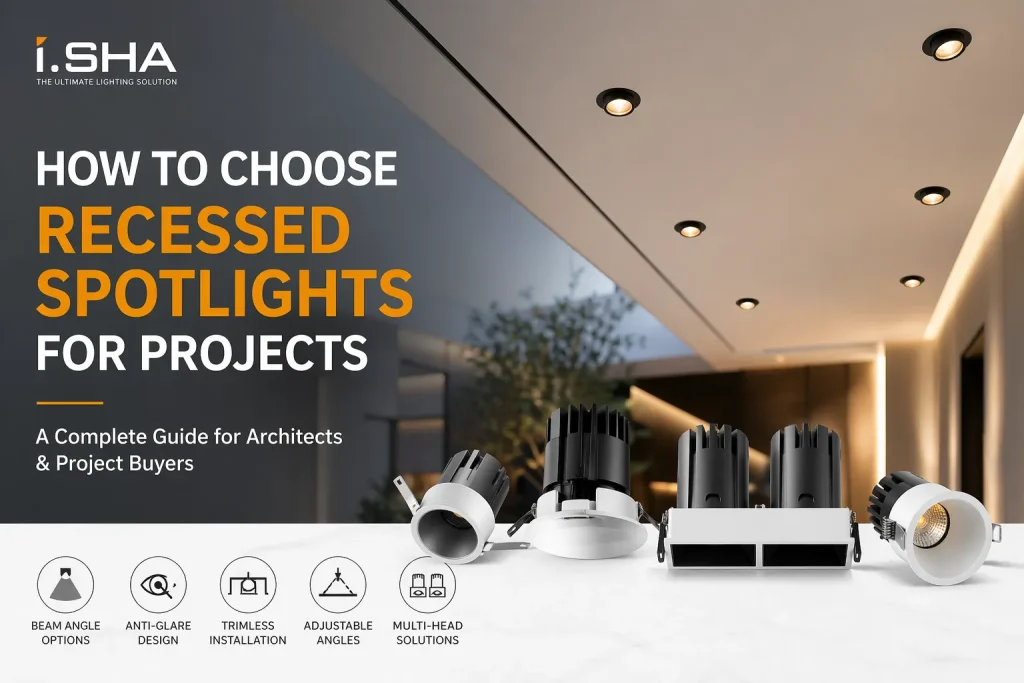
How to Choose Recessed Spotlights for Projects
Choosing the right recessed spotlight for projects is critical for achieving both visual comfort and functional lighting performance. Whether you are an architect, lighting designer, or commercial buyer, selecting the correct project recessed lighting solution directly impacts the overall space quality.
In modern architectural lighting, the demand for architectural recessed spotlight systems continues to grow. However, many projects fail due to improper selection of beam angles, glare control, or installation type. Therefore, understanding the key factors will help you make better decisions.
1. Understand the Application Scenario
Before selecting any recessed spotlight for projects, you must define the application:
- Retail lighting (highlight products)
- Office lighting (visual comfort)
- Residential interiors (ambient + accent)
- Hospitality (aesthetic + atmosphere)
Each scenario requires a different commercial recessed lighting approach. For example, retail projects require narrow beam angles, while offices need wide and anti-glare lighting.
2. Choose the Right Beam Angle
Beam angle determines how light spreads in a space.
Common options include:
- 15° – Accent lighting (art, displays)
- 24° – Focused lighting
- 38° – General lighting
- 50° – Wide illumination
For most project recessed lighting, combining multiple beam angles creates layered lighting. This improves both functionality and visual appeal.
3. Prioritize Anti-Glare Performance
Glare is one of the biggest issues in commercial lighting.
A high-quality architectural recessed spotlight should include:
- Deep recessed light source
- Anti-glare shielding angle (e.g., 60°)
- Uniform light distribution
These features ensure visual comfort, especially in offices, hotels, and residential environments.
4. Decide Between Trimless and Standard Installation
Installation type affects both design and construction.
Trimless (Frameless) Lighting
- Seamless ceiling integration
- Minimalist design
- Popular in high-end architecture
Standard Recessed Lighting
- Easier installation
- Cost-effective
- Suitable for general projects
Many modern recessed spotlight for projects now include both options to meet different requirements.
5. Consider Adjustable vs Fixed Spotlights
Flexibility is essential in project environments.
- Adjustable spotlight (0–30°) → ideal for changing layouts
- Fixed spotlight → stable and cost-efficient
Adjustable models are especially useful in retail and gallery lighting, where direction matters.
6. Evaluate Multi-Head Lighting Solutions
For large spaces, single spotlights may not be enough.
Multi-head recessed lighting offers:
- Higher brightness
- Wider coverage
- Better efficiency for large areas
This type of commercial recessed lighting is commonly used in:
- Showrooms
- Shopping malls
- Open offices
7. Check Power and Size Options
A professional recessed spotlight for projects should provide:
- Multiple wattage options (e.g., 5W–30W)
- Different cutout sizes
- Round and square versions
This flexibility allows project buyers to standardize lighting across different spaces.
8. Focus on Material and Heat Dissipation
High-performance lighting requires durability.
Look for:
- Die-cast aluminum housing
- Efficient heat dissipation design
- Long LED lifespan
Reliable materials ensure consistent performance in long-term project recessed lighting applications.
9. Match Lighting Design with Architecture
Lighting should enhance architecture, not compete with it.
A well-selected architectural recessed spotlight should:
- Blend into the ceiling
- Highlight key areas
- Create depth and layering
This is especially important in modern minimalist interiors.
10. Work with a Reliable Supplier
Choosing the right supplier is as important as choosing the product.
A professional lighting supplier should provide:
- Full product range
- Fast quotation (within 24 hours)
- Project support
- Customization options
If you’re looking for a complete solution, explore our
👉 recessed spotlight series on ishalighting.com
Conclusion
Selecting the right recessed spotlight for projects requires a balance of design, performance, and flexibility. By focusing on beam angle, anti-glare design, installation type, and project requirements, you can create a lighting solution that enhances both functionality and aesthetics.
As modern architecture continues to evolve, high-quality project recessed lighting will remain essential for delivering professional lighting results.
https://addlinks.pro/UPWkv